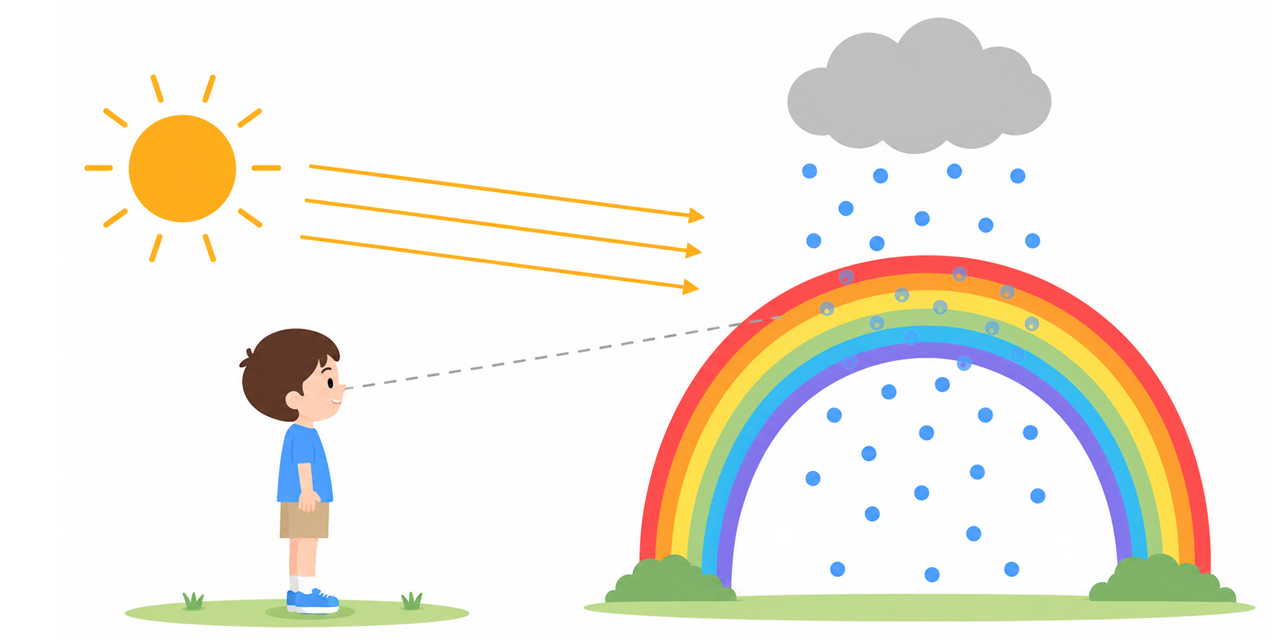
Sunlight looks white, but it's really all the rainbow colors mixed together.
Tiny raindrops in the air bend that light, split it into colors, and send it back to your eyes.
That's a rainbow.
It appears when you stand with the sun behind you, looking toward the rain.
With the sun behind you, look toward the rain — and a rainbow appears.⤢ Tap to enlarge
Side & Front, together. Pause the falling drop, switch primary / secondary, and watch the color form inside one drop — the mechanism and the appearance at once.Open fullscreen ↗
Why seven colors?
Sunlight looks white, but it's a mix of red, orange, yellow, green, blue, indigo and violet. A raindrop works like a tiny glass ball — a prism. As light bends inside it, each color bends a little differently, so the white light fans out into colors. (In truth there are no hard edges between them — the colors blend smoothly.)
Why opposite the sun?
Light bends inside the drop and comes back toward you. So you only see a rainbow with the sun behind you, looking toward the rain. The tip of your own shadow — the point straight opposite the sun — is the center of the rainbow's circle. Rainbows are biggest when the sun is low (morning or late afternoon) and hard to see when the sun is high at midday.
Why is it round (an arch)?
Every raindrop sends its color back at the same angle, around the point opposite the sun. Join up all those points and you get a full circle — but the ground hides the lower half, so we see an arch. In the animation below, watch countless drops build the ring.
Sometimes a fainter bow appears outside the first one. Its light has reflected twice inside the drops, so its colors are reversed (violet on the outside). The sky between the two bows looks a little darker.
Can you reach the end? / Your own rainbow
No — as you walk toward it, the rainbow moves away. A rainbow isn't an object; it's an angle made by you, the light and the drops. So the person standing next to you is seeing their own, slightly different rainbow.
Make your own rainbow
On a sunny day, stand with the sun behind you and spray a fine mist of water in front of you with a hose. A little rainbow appears in the spray — exactly the same physics as the real one in the sky.
More detail (angles & numbers)
The principle — in one line
A rainbow is not an object in the sky, but geometry drawn in the air by the relative position of the light and the observer. For the primary bow, only droplets on a cone 40.7–42.4° from the antisolar point (the tip of your own shadow) reflect the light once off their back surface, split it, and return it to your eye (the secondary bow reflects twice, at 50.4–53.5°). So when the light moves, the colors move; when you move, the rainbow flees.
A tiny change in angle is enough to change the point of color inside the drop.
Primary & secondary — a difference in the number of reflections
Light entering a drop refracts on the way in and on the way out (shared by both bows). The difference is the number of reflections inside the drop.
Primary bow (the bright inner one) = one reflection inside. About 40.7°(violet)–42.4°(red), with red on the outside.
Secondary bow (the faint outer one) = two reflections inside. About 50.4°(red)–53.5°(violet), with the color order reversed (violet outside).
Each extra reflection makes the light weaker and the band wider, so the secondary bow looks fainter and about 1.8× wider; between the two lies a dark band where no light reaches the eye (Alexander's dark band).
Color: a continuous spectrum summed from 12 wavelengths (stepless, not seven discrete bands).
Position of the color point: primary ≈ 0.861R from the drop's edge, secondary ≈ 0.951R (values from the angle of incidence at minimum deviation; they vary slightly with wavelength).
Angles, colors and band widths are all computed from water's refractive index and geometry.
The artwork built on this principle — Light Sculpture
The simulation on this page reproduces, in CG, the angles at which color appears — computed from
water's refractive index and geometry. The footage below, by contrast, is artist
Shinichi Maruyamaactually filming real water droplets in mid-air with a
high-speed camera. It is a record of the photo series Light Sculpture,
capturing the same principle as a single instant of real water.